Learning Shapes in English with Everyday Objects (Kids)
Introduction
Shapes are everywhere around us—on the table, in the kitchen, at the playground, even in the clothes we wear. For children, learning shapes is not just about recognizing circles, squares, or triangles; it’s also about connecting language with the world they see every day. When kids learn shapes in English, they gain two powerful skills at once:
visual recognition and
language development.
This blog post is designed for parents, teachers, and caregivers who want to make learning shapes in English fun, practical, and memorable. By using
everyday objects as teaching tools, children can easily connect the English words for shapes with real-life experiences.
We’ll explore this topic in three major sections:
- Why Learning Shapes in English Matters for Kids
- Everyday Objects as Shape Teachers
- Fun Activities and Games to Reinforce Shape Learning
By the end, you’ll have a toolkit of strategies, examples, and activities that can transform shape-learning into an exciting adventure for kids.
Section 1: Why Learning Shapes in English Matters for Kids
1.1 Shapes as the Foundation of Early Learning
Shapes are one of the first concepts children encounter in early education. Recognizing shapes helps kids:
- Develop visual-spatial awareness (understanding how objects fit together).
- Build pre-math skills (geometry, symmetry, and measurement).
- Strengthen problem-solving abilities (puzzles, building blocks, drawing).
When children learn shapes in English, they’re not just memorizing words—they’re creating a
bridge between language and logic. For example, when a child points to a ball and says “circle,” they’re linking vocabulary with perception.
1.2 Language Development Through Shapes
Shapes are simple, concrete, and repetitive—perfect for language learning. Words like
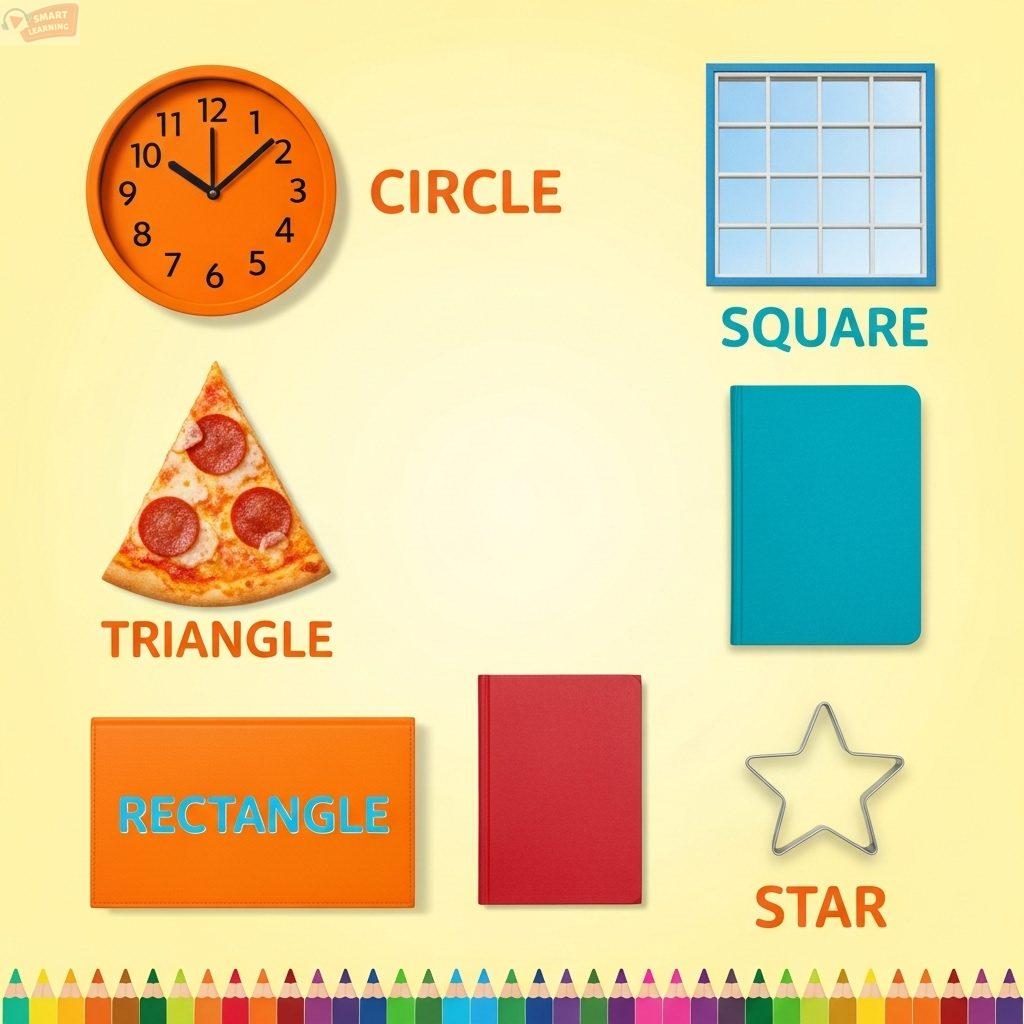
circle, square, triangle, rectangle, star, heart are easy to pronounce and visualize. By practicing these words daily, children:
- Expand their English vocabulary.
- Improve pronunciation through repetition.
- Gain confidence in using English in real-life contexts.
For bilingual or ESL learners, shapes provide a
low-pressure entry point into English. Unlike abstract words, shapes are visible and tangible, making them easier to grasp.
1.3 Shapes as a Cultural and Creative Connector
Shapes also connect children to art, culture, and creativity. Think of:
- Flags (rectangles, stars, circles).
- Architecture (triangular roofs, circular domes).
- Food (pizza slices as triangles, cookies as circles).
By learning shapes in English, kids also learn to describe their world in a new language, making them more observant and expressive.
Section 2: Everyday Objects as Shape Teachers
2.1 Circles in Daily Life
Circles are everywhere! Some examples kids can easily spot:
- 🍎 Fruit: apples, oranges, grapes.
- ⚽ Toys: balls, frisbees, yo-yos.
- 🍪 Snacks: cookies, doughnuts, pancakes.
- ⏰ Household items: clocks, plates, lids.
Teaching tip: Ask children to say,
“This is a circle” while holding the object. Repetition reinforces both the shape and the English word.
2.2 Squares and Rectangles
Squares and rectangles are common in furniture and books:
- 📚 Books and notebooks (rectangles).
- 🖼️ Photo frames (squares or rectangles).
- 🍫 Chocolate bars (squares).
- 📺 TV screens and tablets (rectangles).
Teaching tip: Use building blocks or LEGO to show how squares and rectangles fit together. Encourage kids to say,
“This block is a square” or
“This screen is a rectangle.”
2.3 Triangles in the World Around Us
Triangles are slightly less common but still easy to find:
- 🍕 Pizza slices.
- 🎵 Musical instruments like the triangle.
- 🏠 Roofs of houses.
- 🚸 Traffic signs.
Teaching tip: Draw a triangle on paper and ask kids to find objects that look similar. This strengthens observation skills.
2.4 Stars, Hearts, and Other Fun Shapes
Beyond the basics, children love learning fun shapes like stars, hearts, and ovals:
- ⭐ Stars: stickers, decorations, night sky.
- ❤️ Hearts: Valentine’s cards, jewelry, emojis.
- 🥚 Ovals: eggs, balloons, mirrors.
Teaching tip: Use art and craft time to cut out these shapes. Kids can decorate them while repeating the English words.
2.5 Shapes in Nature
Nature is the best classroom:
- 🌸 Flowers (circles, stars, ovals).
- 🍂 Leaves (ovals, hearts).
- 🌙 Moon (circle, crescent).
- 🐚 Shells (spirals, ovals).
Teaching tip: Take kids on a “shape walk” outdoors. Ask them to point out shapes in English as they explore.
Section 3: Fun Activities and Games to Reinforce Shape Learning
3.1 Shape Hunt (Indoor & Outdoor)
Turn learning into an adventure!
- Give kids a list of shapes in English.
- Ask them to find objects that match each shape.
- Example: “Find a circle in the kitchen” → child brings a plate.
This game builds vocabulary, observation, and excitement.
3.2 Shape Sorting with Everyday Objects
Use household items like buttons, bottle caps, or toy blocks.
- Ask kids to sort them into groups: circles, squares, triangles.
- While sorting, encourage them to say the shape names in English.
3.3 Arts and Crafts with Shapes
- Cut out colored paper into different shapes.
- Let kids create pictures (a house with a square base, triangle roof, circle sun).
- Encourage them to describe their artwork in English: “The sun is a circle.”
3.4 Cooking with Shapes
Cooking is a fun way to learn shapes:
- Cut sandwiches into triangles.
- Use cookie cutters for stars and hearts.
- Make pancakes (circles) or rectangular brownies.
Kids can say the shape names while eating, making learning delicious and memorable.
3.5 Shape Songs and Stories
Music and storytelling make learning stick.
- Sing songs like “Twinkle, Twinkle, Little Star” (star).
- Read picture books that highlight shapes.
- Create short stories: “The circle went to meet the square.”
3.6 Public Speaking Challenge
Encourage kids to present their favorite shape in English:
- Example: “My favorite shape is a circle. I see circles in cookies, balls, and the moon.”
- This builds confidence in speaking English in front of others.
Conclusion
Learning shapes in English with everyday objects is more than just a vocabulary lesson—it’s a
gateway to creativity, observation, and confidence. By connecting shapes to real-life experiences, children not only remember the words but also understand their meaning in context.
Parents and teachers can make shape-learning fun through
games, crafts, cooking, and storytelling. With consistent practice, kids will soon be able to point at the world around them and describe it in English with joy and confidence.
So next time you see a cookie, a pizza slice, or a traffic sign, remember—it’s not just a snack or a symbol. It’s a
circle, triangle, or rectangle waiting to teach a child English in the most natural way possible.

 0 comment
 02 Oct, 2025
Never Learning
0 comment